KEYWORDS: Citation Gap AI Visibility AI Citations AI Search Optimization
Citation Gap Strategy: Get Your Brand Cited in AI Search
SEO
|
October 21, 2026
Ten blue links were once the standard search result. Users are increasingly using ChatGPT, Gemini, Perplexity or Google's AI Overviews to pose a question and read a single generated response. In that answer, you find a few sources in AI searches, and your brand is either one of them or it's not there. This makes AI visibility important for brands that want to appear in AI-generated answers.
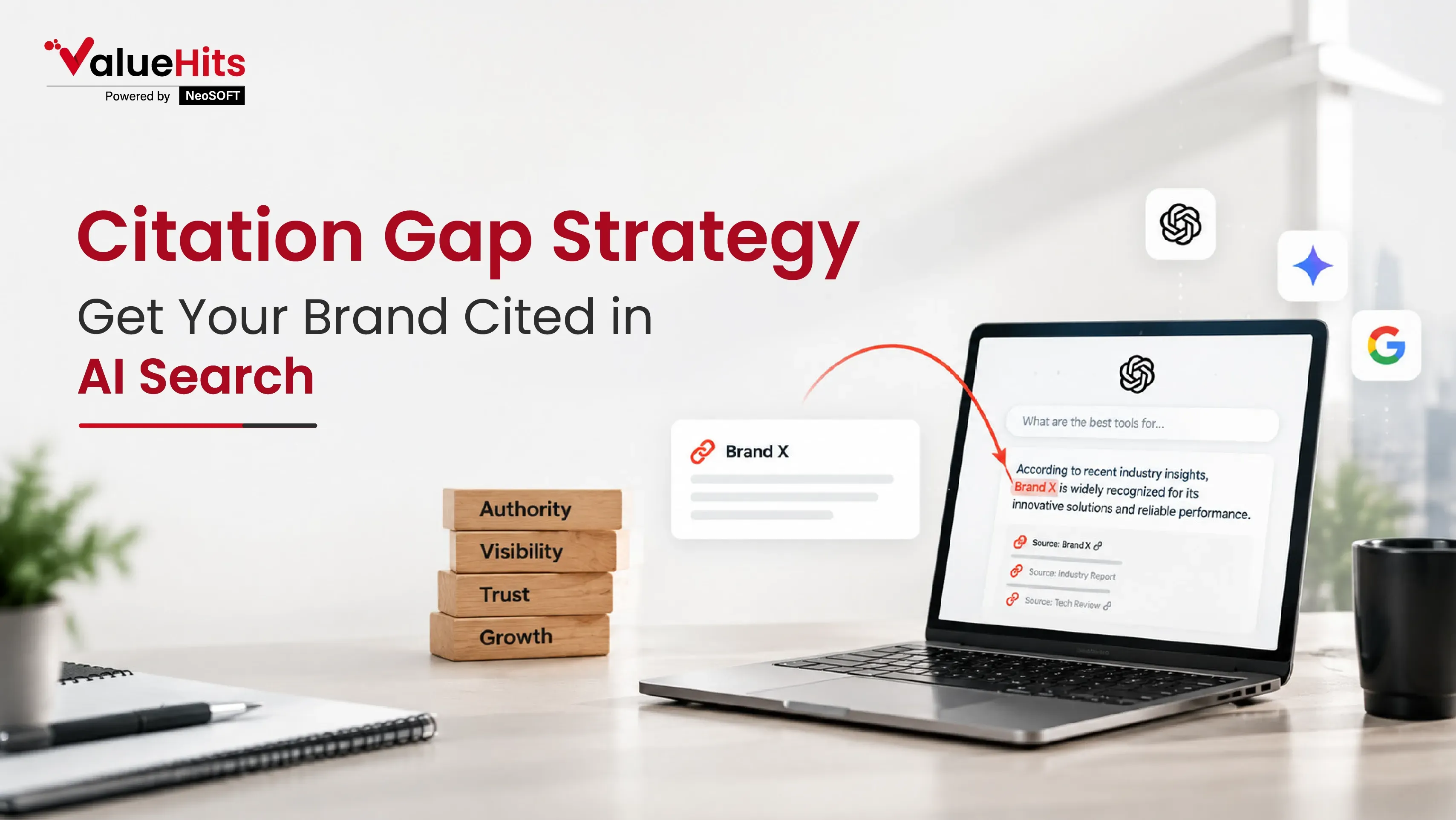
Having a high ranking on Google doesn't automatically ensure that you get mentioned in an AI answer. Check out Google’s guidance on AI Overviews and AI Mode. There are many brands with good SEO that discover that AI tools continue to mention a competitor, a review site, or a forum thread. The Citation Gap is the difference between who is cited and who deserves to be cited.
In this post, I will explain how to measure the gap and how to close it, which is more important, by building the evidence that the AI engines look for. This approach can also help improve brand visibility in AI and strengthen AI search visibility.
What is the Citation Gap?
The Citation Gap is the set of sources that are cited by the AI engines for the target topics that you don't publish on.
AI answer engines are not the ones that optimize the most. They prefer pages that are clear, specific, and verifiable (original data, expert explanations, comparisons, definitions, step-by-step instructions, etc.). If someone else has published that sort of material, and you don't, then the AI doesn't have anything of yours to cite. That's the difference, and it can be addressed.
Steps to Implement the Citation Gap Strategy
Step 1 - Identify what your competitors are cited for
Do research before creating content. Create a quick list of 30 to 50 customer questions that they ask AI tools. It can comprise search intents like:
# Awareness: “What is problem?”
# Consideration: "Best for use case."
# Comparative: "Your brand is compared to another brand."
# Decision: "How much does it cost?”
Repeat each prompt on several engines. Try out ChatGPT, Perplexity, Gemini, and Google AI Overviews. The answer depends on the platform, and a single engine doesn't provide an accurate picture.
Write down for each answer -
- What brand or domain names were mentioned
- What page number is referred to
- The type of content it was (guide, statistics page, comparison, glossary, forum thread)
- If your brand was present or not
Patterns emerge after a couple of dozen prompts. It is possible for one competitor to have all the "how to" questions due to one in-depth article. A third may be quoted for pricing for their clear cost ranges. A third may control comparison queries using a clean feature table.
Those patterns are your map.
Read more: AI Visibility Mapping for Your Brand's SEO
Step 2 - Learn the reasons behind their citations
Avoid copying what the competitors have written. Determine the reason why it was citable. Common reasons can be like -
- Original insights/details. There is something tangible to quote for AI with research, benchmarks, proprietary numbers, etc.
- Direct answers. The answer is given in the first two sentences of the page and then explained.
- Authority signals. Author names, comparison tables, as well as credentials establish trust.
- Correct structure. AI models can extract clear headings, short paragraphs, tables, & FAQs.
- Third-party references. AI gets consistent validation if the brand has evidence on trustworthy websites, review platforms, & communities.
If your pages don't have these characteristics, then you have found the missing evidence.
Step 3 - Create the Missing Evidence
That's where the strategy comes into play. For each gap of high value, develop the asset that an AI engine would want to cite.
- Publish original research. There is no need for a large study. A survey of 100 customers, an analysis of your own campaign data or an annual benchmark report can be a go-to source. Unique numbers are referenced because they are not used by anyone else.
- Answer questions. Revise the needed pages to start with a factual and short answer in the opening sentence. Don't forget to provide context and examples after that. Prepare the decision and comparison text. In case your competitors managed to place themselves on "best X for Y" searches, post a good comparison of yours with clear criteria and compromises.
- Add expert voices. Give articles to actual practitioners with tangible credentials. Use quotes, case studies and personal experience. It's easier to cite authority when it's backed by a real person.
- Make use of structure and format. Provide schema markup (FAQ, Article, Organization, Product), stick to logical headings, and never embed crucial facts in images or PDFs.
- Earn corroboration off-site. All AI engines cross-check that your brand is mentioned correctly in industry publications, review sites, directories, & communities. A consistent signal across trusted sources increases the signal.
Step 4 - Prioritize the Gaps
It's not possible to seal all the holes at once. Rate each one according to the following three factors:
Is this query going to generate revenue for the business?
Gap size: What is the size of the gap between you and the competitor, and what is the thickness of the competitor's coverage?
Effort: How difficult is it to create the missing asset?
Begin with high-value, medium-effort gaps. Often a pricing guide or comparison page will yield quicker results than a comprehensive research report.
Looking to Fill Your AI-Citation Gap?
Become a trusted brand that AI search engines reference in their answers.
Final Step - Measure and repeat the process
Citation share is slow; monitor it on a timeline. Review your prompt list each month and look for:
1. The number of times your brand is mentioned in the prompts, divided by the total number of prompts.
2. The number of different pages that are being cited.
3. The accuracy of AI's brand description changes. AI's brand description accuracy changes.
4. AI-generated referrals from platforms
Think of it as a cycle - audit, publish, re-test, refine. Competitors will adjust, and AI engines will continue to evolve their source selection process.
What Not to Do!
Chasing every prompt. Target questions that are related to your customers.
- Publishing thin content. Articles lacking originality do not merit citations.
- Ignoring accuracy. If AI misidentifies your brand, correct the pages that it is misidentifying and reinforce consistent information on the web.
Consider it as an independent SEO. Technical SEO, quality content and authority remain the pillars. The Citation Gap strategy is based on these.
Frequently Asked Questions
1. What is the difference between SEO, AEO and GEO?
SEO focuses on getting your appear top on the Google search results.
AEO focuses on optimizing your content to provide direct answers to user queries and gain visibility in featured snippets, People Also Ask, voice search, and AI-generated answers.
GEO focuses on increasing the chances of being mentioned, cited, or recommended in AI-generated responses from platforms such as ChatGPT, Gemini, and Perplexity. Still confused? Check Evolution of Search: SEO, AEO, AIO and GEO
2. How is a citation gap different from a content gap?
A content gap is a topic that is ranked by competitors, and you don't have any page about that topic. A citation gap is a topic on which AI engines cite other sources, but you don't. Even if a page has answers, it has a citation gap if the answers are not direct or the page contains no original data or credible authorship.
3. Do backlinks and brand mentions affect AI citations?
Backlinks boost authority and rankings, helping pages be discovered by AI. Whereas mentions on trusted domains allow AI engines to validate your brand. There is no public evidence that there is a minimum/maximum number of links that would lead to a citation, so consider these supporting signals.
4. Does schema markup help my content get cited in AI answers?
While schema can enable search engines to better understand your page, there are no additional requirements or special markup to meet to show up in AI Overviews or AI Mode, Google notes. Describe your content in a schema, and remember the content should match the text you can see, but do not rely on schema for the citations.
5. Do Reddit, Quora and review sites influence what AI cites?
Yes, AI answers will reference forums, review sites, and community conversations, particularly for opinion, comparison, and “best for” queries. Be a true participant: Respond to questions, maintain accurate brand information and foster honest reviews. Don't spam or fall for fake reviews, as it can hurt your company.
6. Can a small or new website get cited by ChatGPT or Perplexity?
Yes. A small site with a niche or very specific guide and original content, can be cited before a larger competitor because of the fact that small sites with original information that answer a question clearly are cited by the AI engines. Even though it's important, authority takes time to earn.
7. How do I track AI referral traffic in Google Analytics 4?
Check your traffic acquisition report for referral sources from AI platforms, such as chatgpt.com, perplexity.ai and gemini.google.com, and group them into a custom channel. Not all AI visits contain referrer information; hence, some of this traffic is going to look direct. For Google’s own AI features, Search Console now has an AI performance report.
8. What should I do if AI gives wrong information about my brand?
Identify the pages that the AI is referencing, which typically include your own website, directories, and even older articles, and make the edits. Consistency of your brand, services, cost and location throughout your website and trusted third-party profiles. After a couple of weeks, retest the prompt again. While AI answers are not directly editable, editing the sources is likely the best path to improvement.
The Bottom Line
AI answers are becoming a front door to your market. The brands that are mentioned are those that have released the most transparent and believable evidence. Analyze your competitors' citations, their reasons, and create more verifiable content on the same topics. Close the gap, and you're no longer invisible in AI answers; you're the source they trust. Consistent content, credible sources and regular tracking can help improve AI visibility and brand visibility in AI search results.
Increase Your AI Search Presence with ValueHits
Finding those gaps in the citations is just the start. ValueHits can help your company find the right content, increase your brand visibility in AI searches & Google search engines, and build an SEO plan that works in this age of artificial intelligence in the search process.
Visit ValueHits now to learn how our digital marketing abilities can help you build your business!
Citation Gap Strategy: Get Your Brand Cited in AI Search
October 21, 2026
Ten blue links were once the standard search result.
Multi-Location GEO Calendar: How to Build a Scalable AI Search Strategy
October 12, 2026
A multi-location GEO calendar is a content strategy that aids businesses in maxi
Facebook Ad Account Hacked? 5 Steps We Took to Take It Back
October 7, 2026
It was a slow Sunday evening when the alert landed.

Hardik Mody
Senior Manager - Digital Marketing atValueHits
Hardik Mody is a Senior Manager in Digital Marketing. He plans and coordinates the marketing activities of ValueHits, a full-service Digital Marketing Agency in Mumbai, India. With his experience and Expert knowledge in the field, he identifies potential customers and develops marketing campaigns. Also, he is efficient enough to meet the client’s requirements and well-organized in handling multiple tasks.