KEYWORDS: Multi-Location GEO GEO strategy Multi-Location SEO GEO Content Strategy Local SEO
Multi-Location GEO Calendar: How to Build a Scalable AI Search Strategy
SEO
|
October 12, 2026
A multi-location GEO calendar is a content strategy that aids businesses in maximizing their performance in several cities and geographical locations through AI searches, unlike an SEO calendar, which mainly revolves around keywords and rankings, a GEO calendar takes into account local search intentions, AI citations, freshness of content, structured data, and customer queries to AI platforms.
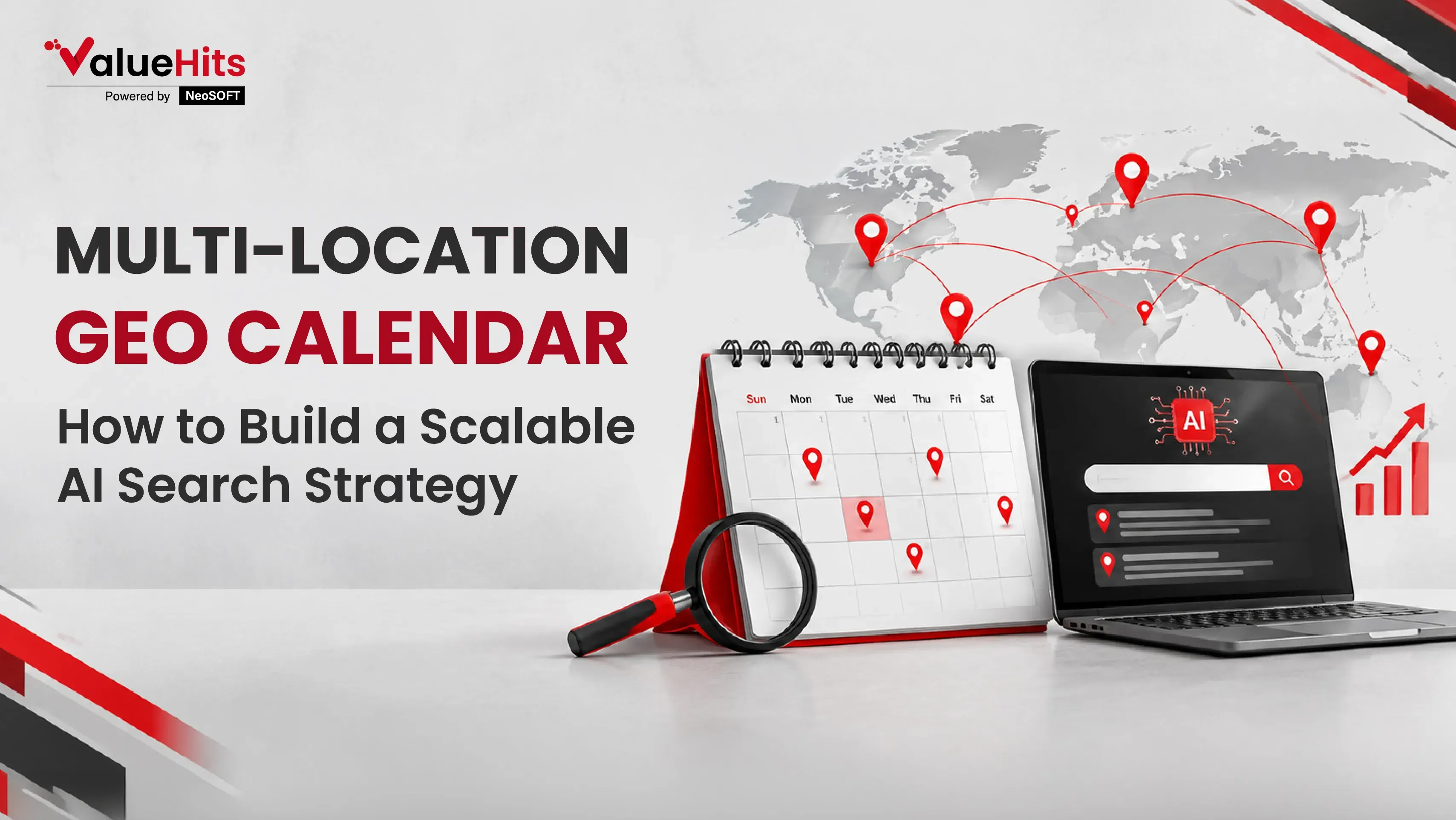
For companies handling tens or hundreds of locations, this strategy helps in providing a consistent content structure for each individual location.
What is Multi-Locations GEO Calendar?
A multi-location GEO calendar structure consists of various geographic levels such as national, regional, city, and individual location pages. Each of these levels fulfills a certain purpose while helping out the other levels via internal linking and unified business data.
Thus, a national company might create a general guide about its services, then follow up with regional-level content that would focus on local trends, city-level guides to answer location-specific questions, and individual location pages to cover the services and opening hours, reviews, and employees.
Such a calendar structure becomes vital when it comes to artificial intelligence searches, as each of the business locations can be viewed as an individual entity. Generic pages may lack sufficient information to help AI systems pick a particular location.
Steps to Build a GEO Content Calendar With Multiple Locations
A scalable GEO content calendar can be structured based on 4 content levels:
1. National/Hub Content:
Generate wide-ranging and expertly curated guides that demonstrate expertise in the products/services/industry.
2. Regional Content:
Include content about regional trends, consumer preferences, regulations, events, etc.
3. City Level Content:
Generate content answering queries related to specific services and customers from specific cities.
4. Location Level Content:
Generate content specific to your location, like services offered, opening hours, personnel at the location, events, reviews, FAQs, etc.
It is not intended to generate the same web page every time but only with different names of cities. The information on each site must be unique and relevant to its local audience. It ensures better geographic relevance and helps AI systems understand individual businesses better.
Content Built Based on Customer Queries
An effective GEO calendar does not have to stop at just search volume and typical keyword research. Instead, find out the queries your customers would pose to Google as well as AI-based applications like ChatGPT, Gemini, and Perplexity
For example, rather than just concentrating on the term "HVAC services," one could talk about:
- HVAC Services Available in [city]?
- Cost of AC Repair in [city]?
- HVAC Services Suitable for Homes in [region]?
- Does this place provide emergency HVAC repair?
- Things that homeowners need to do before contacting an HVAC technician?
Question-related conversational content will assist AI in comprehending the context of the page and providing answers for the search query.
Read more: Top AI Content Optimization Strategies
AI Automation of Image SEO - From Alt Text to WebP Conversion
AI-powered Image SEO is another component of a GEO strategy that involves many locations. If a company has 50 locations, then there may be hundreds or even thousands of images that need to be optimized.
AI can help automate the following image SEO steps.
AI-Generated Image Description
AI-powered image recognition technology enables the analysis of pictures and generation of corresponding alt text according to their contents. Such technology may be helpful when marketers need to describe a number of images in a fast and efficient way.
For example, the alt text of an image that shows the dealership should read: "BMW dealership showroom in Austin, Texas." It is important to maintain accuracy and also to avoid any keyword stuffing.
Naming of Image Files by Using Automation
Automation is helpful when it comes to naming image files in a standardized manner. For example, the name such as IMG_4821.jpg does not provide any useful information, while austin-bmw-service-center.jpg does.
It can be helpful in cases where there are various places that require the standardization of file names.
AI-Driven Image Compression and Conversion into WebP
In the case of large-size image files, page load time can be affected, particularly if there are many images on the page. The AI-Driven process will identify the larger-sized image files and image optimization tools can compress them into the WebP format to make them smaller without compromising visual clarity. The automated procedure will allow resizing, compressing, and converting images for website publication.
Human inspection should continue to be included in the process since AI sometimes misinterprets humans, objects, places, or any other visual element.
Include Structured Data and Local Signals
Structured data should also factor in when developing a geo strategy for multiple locations. Depending on the type of content that is available, the relevant schema types include LocalBusiness, Service, FAQ, Review, and Event.
Consistency of the name, address, phone number, hours of operation, and service offerings on the website and related third-party sites should also be maintained.
Consistent data will help AI comprehend the connection between the brand, the locations, the offered services, and the geographies in which the brand operates.
Plan Content Refresh Dates
A GEO calendar is more than scheduling new content. It also needs to have content refresh dates.
Information about locations changes frequently, including operating hours, services offered, employees, events, and customer FAQs. Including content refresh dates on the calendar will help ensure that old information does not stay online.
Some useful calendar fields are:
- Location
- Content tier
- Topic
- Search intent
- Target audience
- Publishing date
- Image requirements
- Schema requirements
- Internal links
- Refresh date
- Performance metrics
This creates a repeatable system for managing GEO content across multiple markets.
Read more: Evolution of Search: SEO, AEO, AIO and GEO
GEO Performance Metrics
Classic SEO metrics like rankings and organic traffic are useful, but businesses need to consider more GEO metrics.
Measure how often particular locations pop up in AI answers, where there are citations on which pages, what questions make locations visible, and how competitors perform.
Conversions, phone calls, form fills, and other business actions should be tracked as well.
All that creates an endless process of improvement based on a publish-measure-discover-refresh-expand routine.
Final Thoughts
An effective multi-location GEO calendar involves scalable processes along with local content. The aim is not to develop hundreds of pages that are alike but rather create a content ecosystem where there is an interaction between national authority, regional knowledge, city relevance, and local content.
AI may help in this regard since it can help with research, alt text, image names, image compression, and even converting images to WebP format. But human oversight is necessary as well.
For multi-location businesses, GEO is all about providing the right content for the right location, intent, and customer query.
Multi-Location GEO Calendar: How to Build a Scalable AI Search Strategy
October 12, 2026
A multi-location GEO calendar is a content strategy that aids businesses in maxi
Facebook Ad Account Hacked? 5 Steps We Took to Take It Back
October 7, 2026
It was a slow Sunday evening when the alert landed.
AI-Powered Image SEO: Automating Alt Text, Optimization & WebP
September 23, 2026
Yes, AI technology can automate several image SEO tasks, including creating alt text, optimizing

Hardik Mody
Senior Manager - Digital Marketing atValueHits
Hardik Mody is a Senior Manager in Digital Marketing. He plans and coordinates the marketing activities of ValueHits, a full-service Digital Marketing Agency in Mumbai, India. With his experience and Expert knowledge in the field, he identifies potential customers and develops marketing campaigns. Also, he is efficient enough to meet the client’s requirements and well-organized in handling multiple tasks.