KEYWORDS: Google Ads for ecommerce ecommerce PPC increase ROAS ecommerce sales growth PPC for online stores Google Ads strategies for online stores
Google Ads for Ecommerce: 8 Strategies to Increase Sales & ROAS
Making the transition from browsing user to buyer can be the difference between success and failure for many ecommerce companies. Google Ads for ecommerce allows businesses to be there for shoppers who are in the process of deciding which product to purchase. This also allows businesses to be there for shoppers who are comparing prices, and shoppers who are searching for the best place to make their purchase.
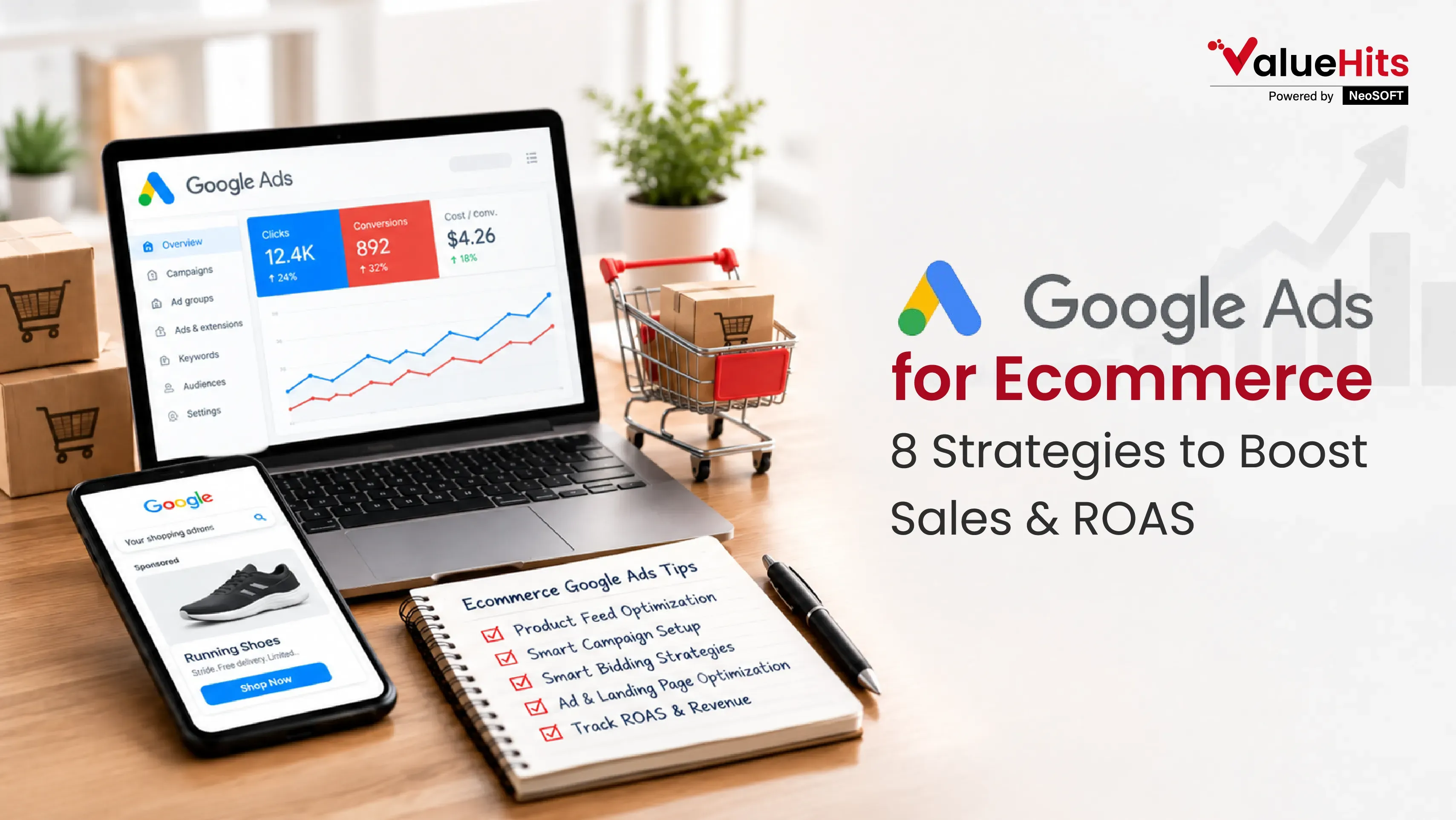
Google reports that over 1 billion purchases are made each day through Google. From this, we can infer that creating ads alone isn't enough. Businesses should strive to create product campaigns that produce profitable sales using their advertising budget.
To do this, businesses should create a product data feed that is accurate and relevant. Also, businesses should be proactive in the optimization of their product campaigns.
There are several ecommerce PPC strategies that businesses can implement to improve their return on ad spending. Let us review some of these PPC strategies.
1. Start with a Strong Product Feed.
Many ecommerce marketing campaigns start with your Google Merchant Center product feed. It comprises titles, descriptions, prices, images, availability, brands, attributes & other details about your products for Google.
Google uses this product information to decide what searches are relevant to your product. Shopping ads are quite different from traditional Search advertisements, as they are based on product data instead of manually selected keywords.
Make sure your product titles contain useful information like -
- ☐ Brand name
- ☐ Product type
- ☐ Description
- ☐ Model/product name
- ☐ Size or Color
- ☐ Relevant Category
- ☐ Salient features
For instance, a title like “Blue Running Shoes” could be improved to “Men’s Blue Running Sports Shoes - Lightweight Cushioned” for better search results.
2. Set Up Your Google Ads Campaigns.
Not all campaigns are the same, and ecommerce companies should not be alike. Shopping campaigns can display product images, prices, store names and other information to shoppers. This helps prospective customers to know what they are getting into before clicking.
You can run Performance Max campaigns to reach users on Google's advertising platforms, such as Gmail, YouTube, Display, Discover, etc. However, search campaigns capture high-intent keywords. A combination of these campaigns targets customers at various points in the ecommerce buying journey.
3. Use separate Brand & Non-Brand Campaigns.
The next important Google Ads optimization strategy is to segment branded and non-branded searches.
A person looking for your brand knows your business; a person looking for a generic product may be learning about your business for the first time. Separate audiences will make performance analysis easier. It also enables advertisers to allocate budgets based on business goals.
For instance, you could have a campaign for -
- ☐ Branded searches
- ☐ Generic product searches
- ☐ Major product categories
- ☐ Best-selling products
- ☐ Seasonal products
4. Strategically use Smart Bidding.
Google Ads ecommerce campaigns are increasingly leveraging automation and machine learning(ML). Smart Bidding strategies automatically adjust bids based on a range of signals that can influence the likelihood of conversion. When sufficient conversion data is available, e-commerce businesses can use these strategies to optimize bidding, improve campaign performance, and increase revenue.
Target ROAS (Return on Ad Spend) can be useful. Automation is not “set and forget”. Before making changes, businesses should track conversion volume, ROAS, product margins, search terms, and campaign performance.
The target ROAS should also be based on profitability. An ad return on product A with a 20% margin can differ quite from that on product B with a 60% margin.
Ready to Turn Clicks into Customers?
5. Track Search Terms & Cut Down Wasted Money.
Broad targeting is beneficial for discovering new search opportunities; however, it can entertain irrelevant search prompts.
One should constantly monitor search terms to identify -
For instance, you could have a campaign for -
- ☐ Irrelevant queries
- ☐ Potential negative keywords
- ☐ Low & high converting queries
- ☐ New customer search queries
Discovering all of these can prevent your ad from showing for queries unlikely to result in a sale. Advertisers can also analyze Search Terms Insights to see what customers are actually searching and categorize search activities.
6. Optimize both Landing Page & Ad
Getting a click is just the first step. Even the most targeted ads can fail to convert if your product page is slow to load, information is unclear, shipping costs are not listed, or checkout is complicated.
The landing page should be as close to the promise as possible in the ad, comprising -
For instance, you could have a campaign for -
- ☐ Clear product images
- ☐ Detailed product information
- ☐ Price and availability
- ☐ Level of reviews and trust signals
- ☐ Return and shipping details
- ☐ A large “Add to Cart” button
- ☐ A straightforward checkout procedure
7. Build a Full-Funnel Ecommerce PPC Strategy.
Not every shopper is ready to make an impulse purchase. Some customers are still in the research phase while others are comparing product prices. Some customers are just looking for the best place to make their purchase.
Using research by Google, 8/10 shoppers' touch journeys are multi-step journeys. Understanding the full journey of the customer, and not just the last step, is important to be successful in your marketing endeavors.
An ecommerce marketing strategy can utilize all three stages of the customer funnel-
- Awareness: PPC marketing is used to capture customers.
- Consideration: Re-target using product ads.
- Conversion: Shopping or Search ads are used.
A complete funnel marketing strategy can help to build a client base on Google's ads platform.
8. Measure Revenue.
While clicks and impressions can give you an estimate of whether your ads are getting attention or not. Ecommerce businesses look into how much money they are making. You need to closely analyze whether the running ads are profitable.
The performance indicators could be like -
- ☐ Conversion rate & value
- ☐ Cost per conversion
- ☐ Average order value
- ☐ Revenue by product & campaign
- ☐ New v/s returning customers
- ☐ ROAS
Businesses see how their ads are performing by tracking sales and revenue from online shopping. This means companies can link their ads to actual orders and revenue, as long as they know what's in shopping carts.
Why Do Ecommerce Brands Need Continuous Google Ads Optimization?
Google Ads is not a campaign that you set and forget. Continuous analysis of factors like competitors, customer behavior, search queries, prices, & seasonal trends can change the whole output.
The facts show that about 15% of all searches are new every day. We can interpret from this that regular monitoring of online campaigns can create new opportunities and save money.
Check Out: Top PPC Agencies in Mumbai, India
Smarter PPC Strategy to Expand Your Ecommerce Business
Instead of focusing on getting the maximum number of ad clicks, companies should target the right customers. They make it easier for shoppers to buy, ensuring they achieve a good ROI (return on investment) and build a stable business.
Want to boost your online store's ads? Hire PPC Experts in India at ValueHits who can help you create a smart Google Ads plan that gets you noticed, drives sales, and makes the most of your ad budget. Contact today!
Google Ads for Ecommerce: 8 Strategies to Increase Sales & ROAS
October 27, 2026
Making the transition from browsing user to buyer can be the difference between success and failu
Citation Gap Strategy: Get Your Brand Cited in AI Search
October 21, 2026
Ten blue links were once the standard search result.
Multi-Location GEO Calendar: How to Build a Scalable AI Search Strategy
October 12, 2026
A multi-location GEO calendar is a content strategy that aids businesses in maxi

Hardik Mody
Senior Manager - Digital Marketing atValueHits
Hardik Mody is a Senior Manager in Digital Marketing. He plans and coordinates the marketing activities of ValueHits, a full-service Digital Marketing Agency in Mumbai, India. With his experience and Expert knowledge in the field, he identifies potential customers and develops marketing campaigns. Also, he is efficient enough to meet the client’s requirements and well-organized in handling multiple tasks.