KEYWORDS: Google Ads vs Facebook Ads Google Ads Facebook Ads Meta Ads
Google Ads vs Facebook Ads: Which Should You Start With in 2027?
PPC
|
November 17, 2026
The choice between Google Ads and Facebook Ads can seem tough in 2027, as both can bring traffic, leads, sales, conversions, and awareness, but in totally different ways. The right platform is not necessarily the best platform; it's where your potential customers are in the buying process.
Typical Google Ads are tied to current demand. People look for products, services, or solutions, and the best time to see an ad is when they are looking for one. Facebook Ads, now part of Meta Ads, is more about finding and building demand by getting your offer in front of people who are interested in it, based on what they do, how they behave, and their demographics they are.
Now you must be wondering, “What is the difference between Google Ads & Facebook Ads, and what should you run first?”
Google Ads vs Facebook Ads: What’s the Difference?
The easiest comparison of the two is: Google Ads captures existing intent, while Facebook Ads creates attention and interest.
If someone is looking for a dentist near them, they already have a need. They're actively searching for a solution. Now a Google Search ad can get a hold of them.
If users visit Facebook or Instagram, they might not be interested in your product. Your ad should captivate viewers when browsing through their feed.
Google Ads are more beneficial for high-intent searches, while Facebook Ads are for new products/services and finding your audience.
Google vs Facebook Ads: Quick Look
Actually, your choice should be according to your business model and customer behavior.
| Factor | Google Ads | Facebook Ads |
|---|---|---|
| Primary Purpose | Capture existing demand | Create and stimulate demand |
| Audience Intent | Usually higher | Lower initially |
| Targeting | Keywords, location, audience signals | Interests, demographics, behaviours, audiences |
| Main Creative | Search text, shopping listings, landing pages | Images, videos, carousels, reels |
| Best Suited For | Services, B2B, local businesses, product searches | Ecommerce, visual and new products, awareness |
| Challenge | Competitive keywords and irrelevant searches | Creative fatigue and audience saturation |
| Buyer Stage | Actively searching / ready to act | Discovering / considering |
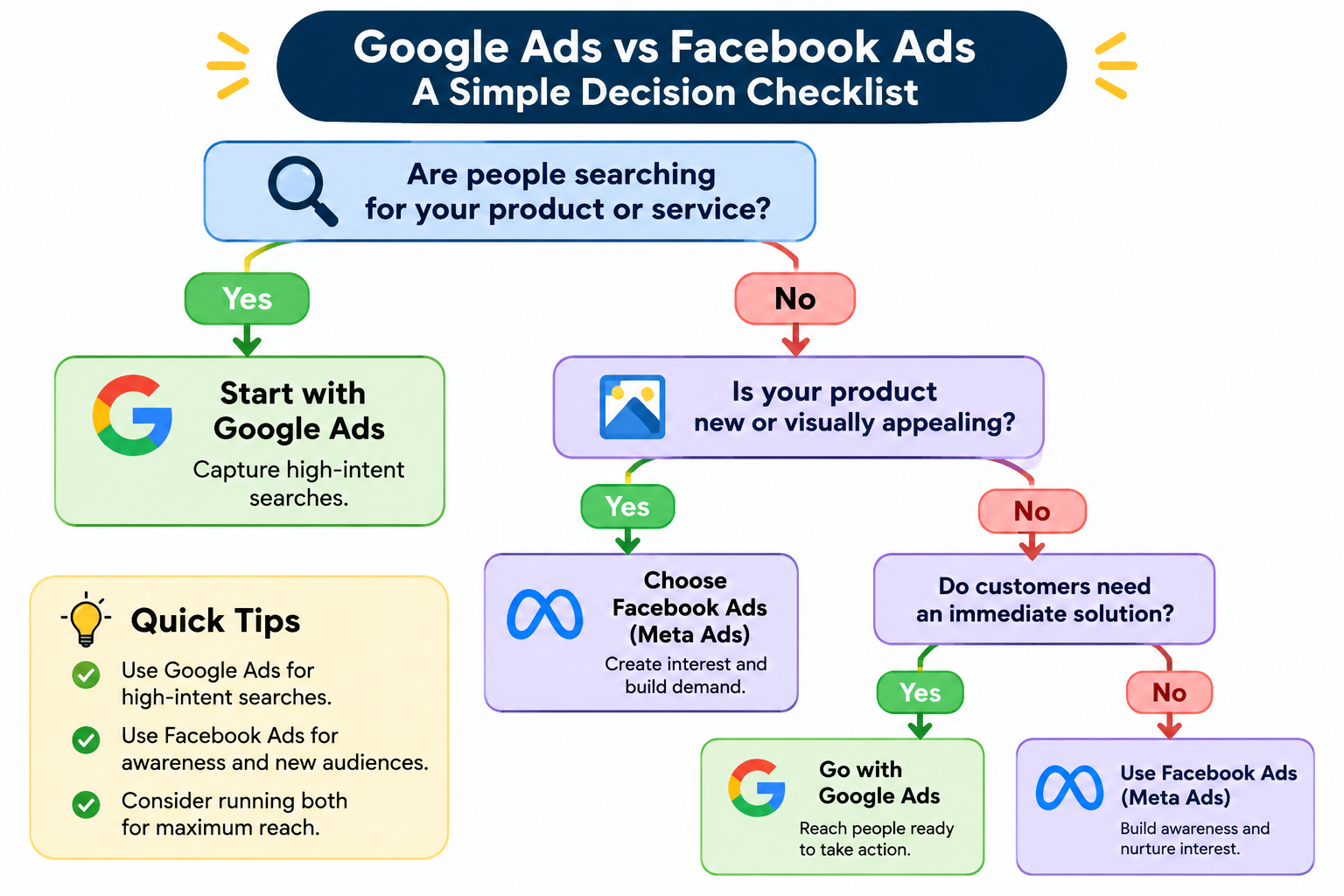
When to Run Google Ads?
1. Clear search demand for product or service
Google gives you a chance to reach an audience that is searching for terms/phrases related to your business. For example, searches like “emergency plumber,” “accounting services for small business,” or “running shoes online” indicate that the person has already identified a need.
Google Keyword Planner can help you understand whether sufficient search demand exists before you invest heavily in advertising.
2. High-intent services
When you urgently need a solution, it is more likely to search than wait for an ad to appear in a social feed. For example, people searching for lawyers, home-repair companies, doctors, clinics, or other professional services.
3. Operating a B2B business
Google can work well for B2B companies when prospects know the problem they need to solve.
For instance, a search for “CRM software for small businesses” or “managed IT services for startups” has a direct commercial intent. Targeting this audience by running relevant search campaigns can give better results than trying to interrupt their social media browsing.
4. Actively searched ecommerce products
Google Shopping and Google Search ads for ecommerce can introduce products to buyers already shopping for the same. The name, category, price, and other specifications about the product can facilitate quicker decision-making.
When to Prioritize Facebook Ads?
If customers aren't looking for your product but are in the right mindset, Facebook Ads might be a more suitable choice.
1. You are introducing a new product or category.
For popular products or new ideas, this will be a great way to generate traffic.
Facebook & Instagram can facilitate the introduction of the product to its relevant target groups. It's easy to communicate benefits and create social media interest. Many of those users are likely to eventually type in your brand or product name when they are looking for it on Google.
2. Your product is highly visual.
Images and videos can help get the job done fast, making it ideal for fashion, beauty, home fitness products, decor, food, and lifestyle products to perform well on Facebook and Instagram.
A short video demonstrating what a product looks like or does could convey more than a search ad.
3. You need to build awareness.
Facebook Ads can target users based on their behavior and attributes, instead of relying on a specific keyword.
This allows the platform to be effective for brands that want to raise awareness before customers are ready to buy.
4. You have strong creative resources.
The quality of the creatives is a crucial element of Facebook advertising. Different images, videos, Reels, different angles to the message & carousels can be tested to find out what resonates with your audience.
The more your business can create new and consistent creative, the better Facebook becomes.
How AI and Automation Are Changing Google Ads and Facebook Ads in 2027?
Advertising powered by artificial intelligence (AI) has become a crucial element of campaign administration on both channels. Rather than making manual adjustments to each of the campaign parameters and/or bids, advertisers are now able to employ automation to maximize the efficiency of their campaigns and improve overall performance.
Google Ads: Performance Max
Google’s Performance Max campaigns are optimized for advertising on Google’s channels (Search, YouTube, Display, Discover, Gmail, and Maps) using artificial intelligence. Advertisers can submit their creative materials, audience signals, conversion objectives, etc., and Google’s automated system will help find potential clients and spend money on ads.
Facebook Ads: Advantage+
Meta's Advantage+ suite uses artificial intelligence (AI) and automated tools to enhance targeting of audiences, distribution of creatives, placement of ads, and performance of campaigns. The use of this tool allows advertisers to find people who are likely to convert, rather than using manual methods of selecting audience groups.
Automation cannot replace human strategic planning. Businesses continue to require effective creative content development, reliable conversion tracking, well-defined campaign goals and ongoing performance evaluation.
For beginners, the AI-powered features will make it easier to manage campaigns; however, understanding the basic principles of paid advertising is still necessary.
What About Running Both?
For many businesses, the answer eventually isn't Google Ads vs Facebook Ads - it's Google Ads and Facebook Ads
How Google Ads and Facebook Ads Work Together Through Retargeting
Google can attract those actively looking for your products or services, and Facebook can reach new people and retarget those who have already interacted with your website or content.
But don't allocate your budget by the dollar from the outset on both channels. Test the channel with the greatest opportunity to succeed, review the outcome, and slowly introduce the next platform.
This strategy allows you to create continuous brand awareness throughout the entire shopping process, reinforces customer buying decisions and creates more chances for conversion. Be certain that your tracking systems, who can receive your messages (audience), what you need to obtain permission from customers (consent), and how you protect customer data (privacy) allow you to implement retargeting campaigns.
Conversion Tracking: How to Measure Advertising Performance
It will be difficult to determine if your advertising dollars are producing a return on investment when you run ads with no way of measuring their effectiveness. To begin running campaigns, set up conversion tracking on each platform.
To start tracking user activity in Google Ads, first set up the Google tag on your website and then link the Google tag to your Google Analytics 4 (GA4) account. Once linked, you will need to configure key events that you want to track using GA4, including forms filled out, purchases made, phone calls received, and any additional valuable customer behaviors. After configuring these events, you can import them into your Google Ads account so you can assess how effective your advertising campaigns are performing based on those converted behaviors.
To measure what users do on your site (e.g. products viewed, items added to a cart, leads generated, purchases made), you can install the Meta Pixel for use with Facebook Ads (which has been renamed as Meta Ads). Additionally, to improve the accuracy of event measurement, particularly if you find that user tracking using browsers is being limited, you can implement the Conversions API in tandem with the Meta Pixel.
Prior to spending money on advertising, verify that conversion events are firing properly. By doing so, you will be able to measure campaigns with true leads, sales, cost-per-acquisition (CPA) and return-on-ad-spend (ROAS) rather than just impressions and clicks.
How Much Should Beginners Spend on Google Ads and Facebook Ads in 2027?
Beginners have many questions when it comes to paid advertising. A common question is, "How much should I spend?" There isn't an exact number that everyone uses for their advertising budgets. However, starting with a lower amount of money and testing your results will usually lead you to a good starting point.
For a small business in India, an initial testing budget could look like this:
| Advertising Platform | Suggested Daily Budget | Monthly Testing Budget |
|---|---|---|
| Google Ads | ₹500–₹1,000 | ₹15,000–₹30,000 |
| Facebook Ads (Meta Ads) | ₹300–₹700 | ₹9,000–₹21,000 |
These are simply examples of initial budgets that you may use as a reference point to begin planning your marketing strategies. These budgets are not guarantees of either minimum spending levels or expected performance results. The amount you spend on marketing will be determined by such factors as the level of competition in your market, the average value of each sale made by your company, the margin of profit you generate from each sale, where you are located, and what specific types of conversions you would like to achieve.
If you are working on a tight budget, don't split your budget equally across both platforms from the very beginning. Instead, start out by testing one platform with multiple types of targeting and/or keyword strategies. Then, assess the value of the leads generated through that platform and determine which strategy produces the best results in terms of generating real business.
After understanding the performance of your campaigns, you may begin to invest more money into the existing platform or add another.
Not sure whether Google Ads or Facebook Ads fits your budget?
Talk to ValueHits’ PPC experts and get a clear starting plan.
Frequently Asked Questions
Q1. Which is better for beginners: Google Ads or Facebook/Meta Ads?
Google Ads is a great choice for newbies who want to connect with individuals who are actively looking for specific goods or services. Facebook Ads is ideal for raising brand awareness, targeting new demographics, and promoting visually appealing products.
Q2. How much do Google Ads and Meta Ads cost?
You decide how much to spend. Both platforms let you set a daily or monthly budget, with no fixed minimum. What changes is how far that budget goes, because the cost per click or lead depends on your industry, competition, keywords, audience, and campaign goal.
Google Ads can cost more per click on competitive keywords, while Facebook (Meta) Ads often cost less for awareness and engagement. Start with a budget you can afford to test, track your cost per lead or sale, and increase spend only on what performs.
Q3. Do Google Ads and Facebook Ads work for small businesses?
Yes, you can indeed make use of both platforms in small businesses. Google Ads is great for attracting potential customers who are actively seeking a solution, and Facebook Ads works well for businesses finding new customers and generating interest in their product or service.
Q4. What if I have a very small budget?
Focus matters more than the platform. Splitting a small Ad budget across both means neither gets enough data to learn from.
- Pick one platform and one goal, such as leads or sales.
- On Google, target specific high-intent keywords in a tight location and add negative keywords.
- On Facebook, run one audience with 2-3 creative variations and keep the best performer.
- Set up conversion tracking first so you measure results, not just clicks.
- Scale only what works before adding the second platform.
In the end, the most effective platform is the one that corresponds with the behavior of your customer and not the one that is in vogue.
Wrapping Up
Google and Facebook Ads are used for different purposes. Google Ads works better for known search intent and high purchase intent. Whereas Facebook Ads can be more beneficial for creating awareness, targeting new audiences, and promoting new products.
When your customers are already looking for your solution, Google could be the obvious place to begin. If they realize the need for your product first, Facebook might be the recipient of the first half of your advertising dollars.
The smartest approach is to test based on your goals, audience, margins, creative capabilities, and conversion data - and then scale the channel that produces meaningful business results.
Ready to Build a Smarter Paid Advertising Strategy?
Not sure whether Google Ads or Facebook Ads is the right starting point for your business in 2027? ValueHits can help you identify the right paid advertising strategy, reach high-value audiences, optimize campaigns, and turn your advertising budget into measurable business growth.
Get in touch with our PPC Expert at ValueHits today and take the guesswork out of your digital advertising strategy.
Google Ads vs Facebook Ads: Which Should You Start With in 2027?
November 17, 2026
The choice between Google Ads and Facebook Ads can seem tough in 2027, as both can bring traffic,
Why News Mentions Help You Show Up in AI Answers
November 6, 2026
You type a question into ChatGPT, Gemini, Perplexity, or Google’s AI Overview.
Google vs. Microsoft AI Max Campaign: Who Wins the Search Battle?
November 2, 2026
Microsoft recently made a big, important move by launching AI Max for search campaigns globally,

Hardik Mody
Senior Manager - Digital Marketing atValueHits
Hardik Mody is a Senior Manager in Digital Marketing. He plans and coordinates the marketing activities of ValueHits, a full-service Digital Marketing Agency in Mumbai, India. With his experience and Expert knowledge in the field, he identifies potential customers and develops marketing campaigns. Also, he is efficient enough to meet the client’s requirements and well-organized in handling multiple tasks.