KEYWORDS: AI Max Google AI Max Microsoft AI Max Microsoft Advertising Google Ads AI Max campaign
Google vs. Microsoft AI Max Campaign: Who Wins the Search Battle?
Microsoft recently made a big, important move by launching AI Max for search campaigns globally, and the tool has changed how we run ads. It helps ads reach more people and match what they are looking for. Since Google also has AI Max, many advertisers are asking a big question: are they the same?
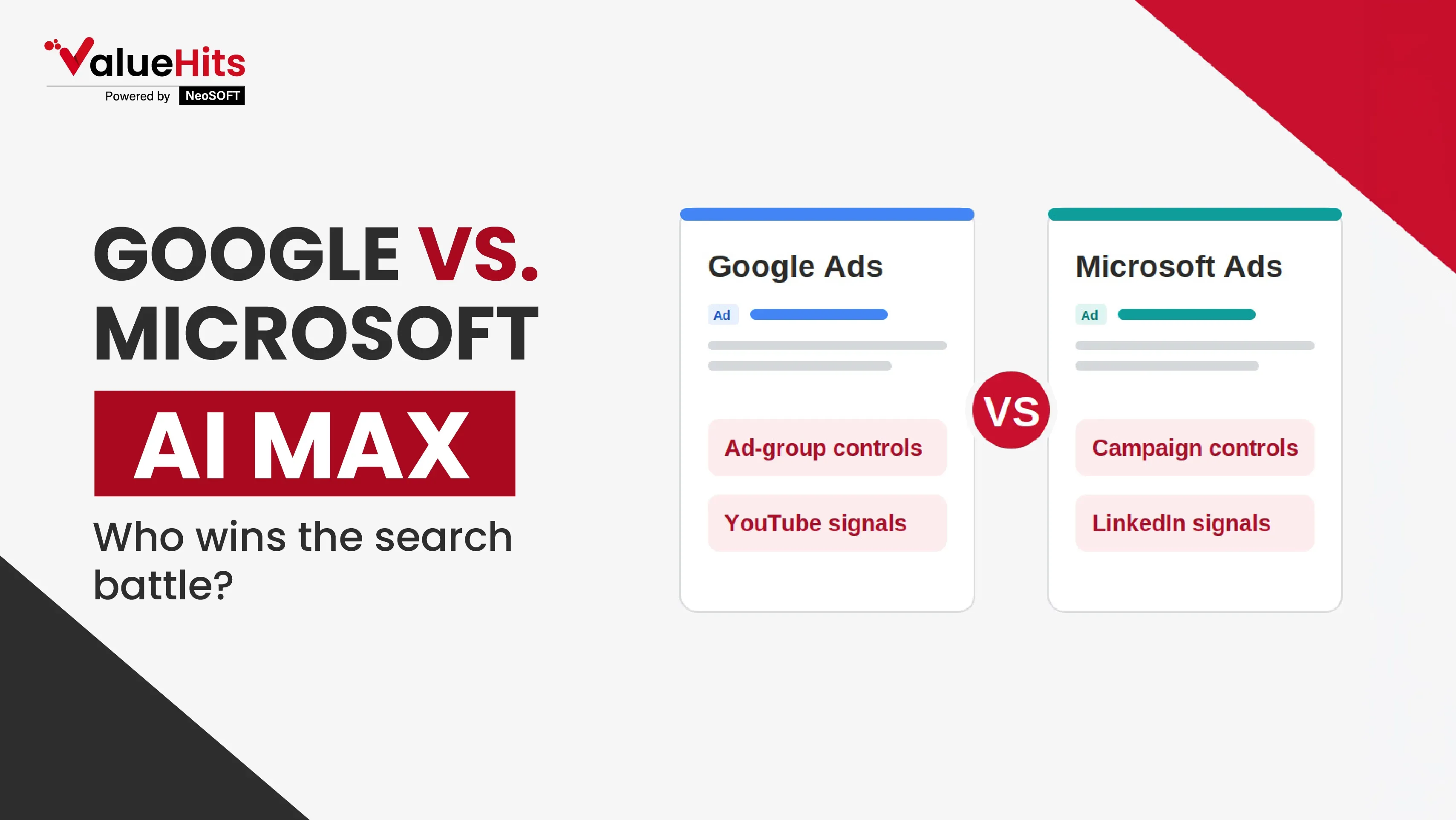
This guide on Google vs. Microsoft AI Max Campaign will show you how Microsoft’s new launch compares to Google's version.
Prime attributes of Core AI Max
Both platforms focus on three main tools to get better results:
- Search term matching: This helps your ads show up for a wider range of searches.
- Text customization: Customization precisely tests different ad copies to see what works best.
- Final URL expansion: It directs the users to the best page on your site, even if it is not your main link.
Key Areas of Comparison
We will look at three big topics to help you understand these tools:
- Similarities between Google and Microsoft AI Max.
- Key differences between the platforms.
- How to use AI Max in new and existing account structures.
What’s the Same with Google and Microsoft AI Max?
AI Max Is a Setting, Not a Campaign Type
First, you need to know what AI Max actually is. AI Max is an optional setting. It is not a brand new campaign type. You turn these features on inside your normal Search campaigns. It just gives your standard ads an extra boost with smart technology.
How the Three Core Features Work Together
For the best results, both Google and Microsoft want you to use all three tools at the same time:
- Search term matching: Finds the people searching for what you offer.
- Text asset generation and customization: Writes the right message for those people.
- Final URL expansion: Sends those people to the exact right page to make a sale.
Testing AI Max Through Experiments
You should not just turn AI Max on and hope for the best. What is actually needed is to perform proper testing, and here is how to do it:
- Selecting a strong campaign: Always opt for a campaign that already gets good results and has plenty of data.
- Creating a 50/50 traffic split: For creating a 50/50 traffic split, one needs to send half of your traffic to your normal ads and half to the AI Max ads.
- Allowing sufficient time for learning: Give the algorithm some time to learn, and try and keep the campaign unchanged for at least two weeks before making any further changes.
- Measuring business outcomes: Always have a closer look at the actual sales and leads, not just how many clicks you got.
Conversion-Based Bidding Is a Core Part of Search Term Matching
To get the most out of AI Max, you need to use smart bidding. AI Max needs to know what a "win" looks like for your business. When you use conversion-based bidding, the AI learns which search terms actually lead to a sale.
If you’re new to this kind of matching, our guide on how to use broad match keywords explains how it widens your reach.
Conversion Data Requirements
The AI needs the conversation history to perform better. It looks at your past conversation data. If your conversation data is poor, then AI will make poor choices.
Using Micro-Conversions and Strategic Conversion Values
If you do not get a lot of big sales, you can track smaller steps. These are called micro-conversions. Things like watching a video or filling out a short form count. You can assign different values to these steps so the AI knows what matters most.
Brand Controls Exist on Both, Though There Are Some Differences in What’s Available
You want to protect your brand name. Both Google and Microsoft let you set rules so your ads do not show up where they should not. But they handle these rules a little differently.
Google Brand Controls
Google comes with its unique and efficient ways to protect your brand:
- Brand inclusions: You can pick specific brands to show up for.
- Brand exclusions: It allows you to block specific brands so your ads stay away from them.
- Term exclusions: Here, you can block certain words from triggering your ads.
- Message constraints: It allows setting rules about what your ad text says.
Microsoft Brand Controls
Microsoft gives you similar tools to keep your brand safe:
- Brand inclusions: You can build lists of allowed brands.
- Brand exclusions: You can build lists of blocked brands.
- Term exclusions: You can block exact phrases.
- Message constraints: You can review and control the text variations.
Disclaimer Handling
Sometimes, your business legally has to show a disclaimer. Both platforms offer ways to pin these important messages to your ads so the AI does not remove them.
What’s Unique Between Google and Microsoft AI Max?
Consolidation of Settings vs. Being Able to Pick and Choose All Three
Here is a major difference. How you turn on the tools is not the same.
Microsoft’s Campaign-Level Controls
Microsoft lets you turn the AI Max settings on or off at the campaign level. You can also pick and choose. You can turn on search matching but leave URL expansion off. This gives you strict control.
Google’s Ad-Group-Level Controls
Google puts more of the AI Max choices at the ad group level. You can make very detailed choices for specific groups of ads, rather than changing the whole campaign at once.
Differences in Campaign and Ad-Group Management
Because of this, you manage your accounts differently. With Microsoft, you make big choices for the whole campaign. With Google, you make smaller, detailed choices for each ad group.
Since Google is changing how Search campaigns should be structured, it’s worth reviewing Google’s new Search Ads rules before deciding how to set up AI Max.
Matching Mechanics and Search Term Transparency Are Different
How the platforms find the right users and how they report the data to you is very different.
Search Term Reporting and Transparency
Advertisers love to see exactly what users typed into the search bar. Both platforms hide some data for privacy, but their reporting rules are not exactly the same.
Google’s Matching Signals
Google uses its massive network to figure out user intent. They look at:
- YouTube data: What videos the user watches.
- Previous search behavior: It lists the exact user searches in the past.
- Conversion data: It highlights what all specific events led to a sale before.
- Landing pages: The precise words listed on your website.
- Other keywords in the ad group: It shows how the used keywords relate to each other.
- Audience signals: Key details on the user habits as per the demographic profile.
Microsoft’s Matching Signals
Microsoft relies on diverse data tools to find the right users:
- LinkedIn data: They use professional profiles and job data.
- Previous search behavior: What exactly users look for on Bing.
- Conversion data: Signals previous sales and leads.
- Landing pages: The content on your site.
- Other keywords in the ad group: Themes specifically followed in your ad group.
- Audience signals: User habits and interests.
Audience signals: User habits and interests.AI Max in Existing and New Account Structures?
Before you start using AI Max, there are five important questions you need to ask yourself.
Do You Trust Your Conversion Measurement and Do You Meet Conversion Thresholds?
AI Max is only as smart as the data you feed it. You need to make sure your tracking works perfectly.
Conversion Data for Established Accounts
If your account is old and has a lot of good sales data, AI Max will love it. You can usually turn it on and enhance the results right away.
Preparing Newer Accounts for AI Max
If your account is brand new, be careful. You need to build up a history of sales and leads first. Give your account time to learn before you let AI Max take over.
Will Your Landing Pages Be a Help or a Hindrance in Conveying Who You Are to the Ad Platform?
AI Max reads your landing pages to learn what you sell. If your page is confusing, the AI will get confused too.
Making Landing Pages Clear and Accessible
Your website needs to be easy to read. Put your main keywords and clear details right on the page. Use simple menus and clear headlines.
Using Image and Video Alt Text
Algorithms cannot "see" pictures. They read the hidden text attached to the picture. Make sure you use good alt text for your images and videos.
Ensuring Search and AI Crawlers Can Access Relevant Content
If your website follows settings that block search engine bots, AI Max cannot read your pages. Make sure your site code allows crawlers to look around.
Evaluating AI-Generated Assets Before Activation
Before you let the AI show ads to real people, look at what it made. If the AI writes a bad copy, it means your landing page needs better words.
Are Your Existing Ad Assets On-Brand or Do They Have Serious Deviations?
The AI will mix and match your old ad text to make new ads.
Auditing Ad Copy and Messaging
Look at all your old ads. If you have some old, irrelevant ads still running, the AI might use them. Delete any text you do not want the AI to copy.
Aligning Existing Assets with Brand Guidelines
Make sure everything in your account matches your current brand voice. The AI is a mirror. It will reflect whatever you give it.
Is PMax Already Part of Your Account Structure?
Performance Max (PMax) is another type of campaign. You need to know how it works with AI Max.
Identifying Incremental Opportunities
AI Max is for Search only. PMax runs across all networks like video and display. Look for ways they can help each other without fighting for the same clicks.
Check Out: PMax Campaign Strategies for Dental Clinic
Using AI Max for Search-Specific Objectives
Use AI Max when you want total control over search text. It is great for people who are ready to buy right now.
Evaluating Combined Performance
Watch your reports closely. Make sure that using the work AI Max campaign actually gets you more sales, not just higher costs.
Have You Budgeted for the Targets You’re Setting?
AI is fast and can spend money quickly. You have to tell it your limits.
Grouping Products and Services With Similar Economics
Group things together that make you the same amount of money. Do not put cheap items and expensive items in the same ad group.
Managing Conversion Values and Target ROAS
Tell the system how much you want to spend to get a sale, and also keep a close eye on your Return on Ad Spend (ROAS) goals.
Setting Appropriate Budgets
Give the AI enough budget to test things out. If your budget is too small, the AI will get stuck and stop working.
Key Takeaways
Google and Microsoft AI Max are counted among highly powerful tools that share many of the same core ideas. They both use search matching, text changes, and URL expansion to get you more sales. Both platforms agree that using all three features together brings the best results.
However, both the tools offer control in unique ways. Microsoft focuses on campaign-level choices. Google asks you to make choices at the ad group level. By testing carefully, fixing your landing pages, and watching your data, you can succeed on both platforms.
Embrace expert support from Value Hits!
To remain ahead of the curve with search strategies and AI tools, it is recommended to work with an expert team. Whether you are looking for help in setting up AI Max campaigns, fixing your landing pages, or driving more conversions, getting professional support will make a smart choice. If you want to see real business growth, reach out to the PPC Experts in India at ValueHits to build a strategy that works for you.
Google vs. Microsoft AI Max Campaign: Who Wins the Search Battle?
November 2, 2026
Microsoft recently made a big, important move by launching AI Max for search campaigns globally,
Google Ads for Ecommerce: 8 Strategies to Increase Sales & ROAS
October 27, 2026
Making the transition from browsing user to buyer can be the difference between success and failu
Citation Gap Strategy: Get Your Brand Cited in AI Search
October 21, 2026
Ten blue links were once the standard search result.

Hardik Mody
Senior Manager - Digital Marketing atValueHits
Hardik Mody is a Senior Manager in Digital Marketing. He plans and coordinates the marketing activities of ValueHits, a full-service Digital Marketing Agency in Mumbai, India. With his experience and Expert knowledge in the field, he identifies potential customers and develops marketing campaigns. Also, he is efficient enough to meet the client’s requirements and well-organized in handling multiple tasks.